- Date
- 23rd November 2026
- Categories
- eCooking, Institutional Cooking, Solar
By Joseph Kariuki, Research Associate, Gamos East Africa.
This article follows the first blog in the series, which presents the detailed SKACS and eSKACS findings on daily energy consumption, cooking times, dish records and meter comparisons. This second article focuses on what happened after schools transitioned to electric cooking and what the field experience suggests for future institutional projects. The lessons emerged between June and October 2026 while the MECS Kenya team worked with Ecobora and 12 participating schools: six grid-connected and six solar-electric.
Our key learning from this exercise is that installing an institutional electric cookstove is a major step in a school’s clean cooking transition, but sustained use develops through everyday kitchen experience. Cooks must learn how the appliance behaves with familiar dishes and large batches. Technical faults and power interruptions must be resolved quickly, and the energy system must match the school’s meal timetable. School administrators in particular benefit from accessible energy consumption data, which enables them to understand the budget implications of the electric cooking transition.
Why school day observation mattered
Daily meter readings showed that electricity consumption rose or fell, but they did not explain why. By following the full cooking day, enumerators documented which dishes and meals were prepared, where cooking was interrupted and why and when firewood was still used alongside electric stoves. The observations identified three recurring causes: stove or pot-capacity limits, cooks’ uncertainty about preparing particular dishes or adjusting temperature settings, and disruptions involving the electricity or solar supply or the cooking equipment itself.

Full-day observation also showed why support cannot end on the day the appliances are installed and commissioned. Initial training introduces the controls, but habits form under real mealtime pressure and become visible only after cooks have used the system repeatedly. Returning later enabled the team to address the operating questions that were affecting daily use.
Grid electricity and confidence in the cooking schedule
School meals must be ready at fixed times. When a blackout, low voltage or blown fuse interrupts a large pot partway through cooking, cooks still have to meet the serving deadline. During observation generally, the cooks transferred food to traditional pots and lit firewood or used a backup generator where one was available. During rainy periods, damp firewood produces heavy smoke and slower heating. Repeated interruptions therefore made backup firewood part of the normal routine even when the electric cookstove itself was working.
This makes communication with the electricity utility a key part of maintaining the cooking system and schedule. Building on wider engagement between MECS and the Kenya Power and Lighting Company, the project team connected participating schools and technical partners directly with utility contacts to report outages, phase imbalances and solve voltage problems quickly to reduce the time that unresolved supply problems disrupted cooking.
Future school eCooking programmes should establish a clear reporting route before problems arise. School administrators need to know whom to contact, which supply or meter information to provide, and how the technology provider and utility will coordinate a response. The effectiveness of such arrangements should be tracked over time before they are proposed as wider service models.
Solar electricity and managing the whole system
At solar-electric schools, operating the cookstove and managing the energy system were closely linked. Cooks often began work between 5:00 am and 7:30 am, before solar generation peaked (or even begun!). They knew how to switch on the appliance but often had less knowledge or experience in dealing with battery state of charge, cloudy-day generation, or the effect of heavy loads early in the morning. A protective low-charge cut-off or slow heating could therefore be interpreted as a stove breakdown.
Field support looked beyond the cookstove controls to the whole system and kitchen workflow. Site-specific guidance covered matching high-demand boiling to stronger solar hours, pre-soaking cereals, splitting food into sequential batches and using two stoves together where available. Operational adjustments have limits: when a school’s meal volume or early-morning schedule exceeds the installed battery, array or appliance capacity, workflow changes cannot substitute for adequate system sizing.
Refresher training, staff turnover and shared responsibility for aftercare
Commissioning demonstrations cannot anticipate the pressure cooks face during a busy term. During the study, cooks rarely adjusted temperature settings or switched off cookstoves early to allow stored heat in the insulated pot to finish cooking. Some worried that heavy dishes would not be ready on time and kept the stove running at full heat. Additional cook training later in the study covered temperature adjustment, steam and lid safety, appliance maintenance and self-cooking. At one school, follow-up guidance reduced energy consumption of active githeri boiling from approximately four hours to two. The UPISHI interface being introduced by Ecobora provides another form of support through dish-specific preset times, automatic switch-off and manual adjustment.

Aftercare depends on information reaching the right people. Cooks may continue working around a system problem without reporting it, and school management may not tell the technology provider when new kitchen staff are appointed. The provider may therefore be unaware of a fault or training need until monitoring shows that electricity use has fallen or the school has stopped using the cookstove. Cooks and supervisors need responsibility for daily checks and prompt reporting, while appliance faults, electrical issues and supply problems are escalated to the technology provider, a qualified electrician or the utility.
Staff turnover makes ongoing training and kitchen reference materials especially important. New cooks and relief staff may receive little formal orientation if their appointment is not communicated to the provider. A simple onboarding routine, supported by visual kitchen guides covering common dishes, temperature settings, self-cooking, routine maintenance, basic system checks and service contacts, can preserve safe and effective operation when staff change.

Reliable monitoring as part of aftercare
Reliable energy monitoring supports research, school management and aftercare. When physical meters, data transmission and platform reporting work together, schools can access dependable daily consumption information, while technology providers can identify interruptions or unusual patterns and respond more quickly. During eSKACS, Ecobora used the comparisons to continue improving its smart meter and Emissionfy platform so that school administrators can understand energy use and track operating costs.
Monitoring can also provide an early warning. A sudden drop or increase in daily electricity use can prompt a conversation with the school and reveal an unreported appliance problem, a power-supply issue or a new cook who needs training before there is a return to firewood. This approach is relevant to any technology provider: monitoring should become part of after-sales service by triggering timely support, rather than serving only as a research record.
Practical lessons for future projects
- Plan structured support after commissioning. Schedule follow-up after cooks have used the equipment under normal school conditions and real workflow, capacity and scheduling questions have emerged.
- Design training for observed practice and staff turnover. Use real cooking sessions to reinforce temperature adjustment and self-cooking, provide clear kitchen guides, and establish an onboarding routine for newly appointed cooks.
- Treat the energy supply and pot capacity as part of the kitchen. Grid stability, solar recharge, battery availability, appliance capacity and fixed meal times determine whether cooks can rely on electricity without falling back on firewood.
- Build permanent escalation routes that work. Schools need direct reporting channels that distinguish daily operating questions from faults requiring the technology provider, an electrician or the utility.
- Use monitoring proactively. Verify the path from the physical meter to the platform, provide understandable daily totals to school managers, and respond when remote data shows that a system is no longer being used.
- Keep backup-fuel use visible. Track whether firewood use reflects capacity limits, power interruptions or training needs so that the cause can be addressed.
From installation to sustained use
The central lesson learnt from supporting these eCooking project during eSKACS is that the journey of clean cooking adoption continues long after equipment arrives in the kitchen. The observations came from schools using Ecobora systems, but the lessons apply more widely to institutions, utilities and companies delivering grid-connected or solar electric cooking. Schools, cooks, technology providers, utilities and research teams each hold part of the operational picture. Full-day observation connected meal deadlines and pot capacity with energy supply, equipment performance, staff practice and the support available when something changed.
The next step is to test these support arrangements over time. Future work should examine whether clear reporting channels significantly shorten interruptions; whether onboarding and additional training sustain correct appliance use; whether remote monitoring identifies non-use early; and whether systems are sized for the school’s largest meals and full cooking schedule. Building these elements into project design can help institutional electric cooking move from successful installation to reliable everyday use.
………………………………………………
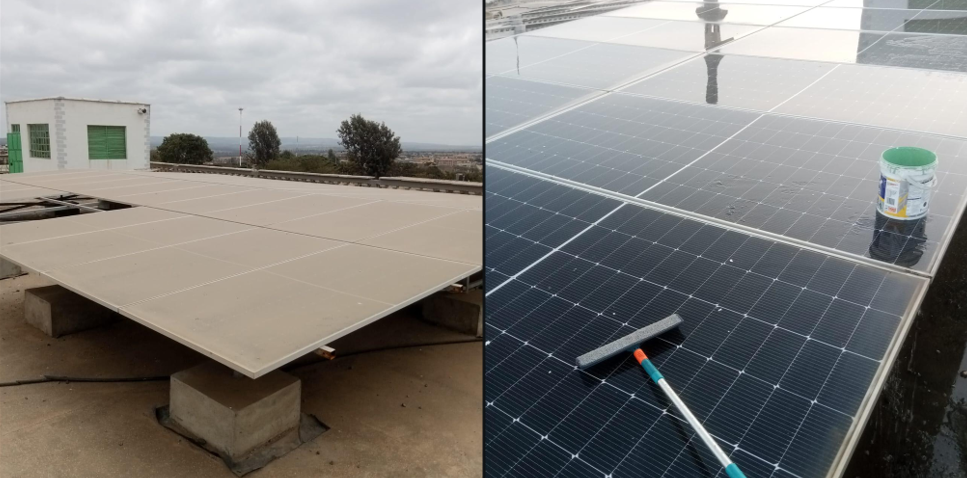
Featured image, image 2, top: Dirty solar panels reduced generation and limited cookstove use; cleaning the panels helped restore output and support reliable operation of the wider solar system. (Photo Credit: Joseph Kariuki, Gamos East Africa).
AI declaration: The blog was human written and tidied up by AI.