- Date
- 27th November 2026
By Dr Yesmeen Khalifa (MECS programme, Loughborough University)
At COP31 in Antalya, Türkiye, eCooking featured prominently in discussions on electrification, clean cooking finance, public health and sustainable development. National commitments, initiatives to expand eCooking in public institutions and new financing approaches reflected growing efforts to integrate eCooking into wider energy transitions.
At the Leaders’ Roundtable on Clean Cooking in Africa on 12 November, IEA Executive Director Fatih Birol stressed the urgency of addressing clean cooking access, with nearly one billion people across sub-Saharan Africa still relying on polluting cooking fuels. This political momentum is encouraging, but scaling eCooking raises an equally important question: how can these transitions advance energy justice, ensuring that benefits, opportunities and costs are shared equitably across different communities and population groups?
From expanding access to achieving energy justice
At the Leaders’ Roundtable, Tanzania’s President Samia Suluhu Hassan stated:
“Our success must be measured not only by the resources we mobilise, but by the number of families gaining access to affordable, reliable and sustainable clean cooking solutions.” IEA statement and recording, 13:24
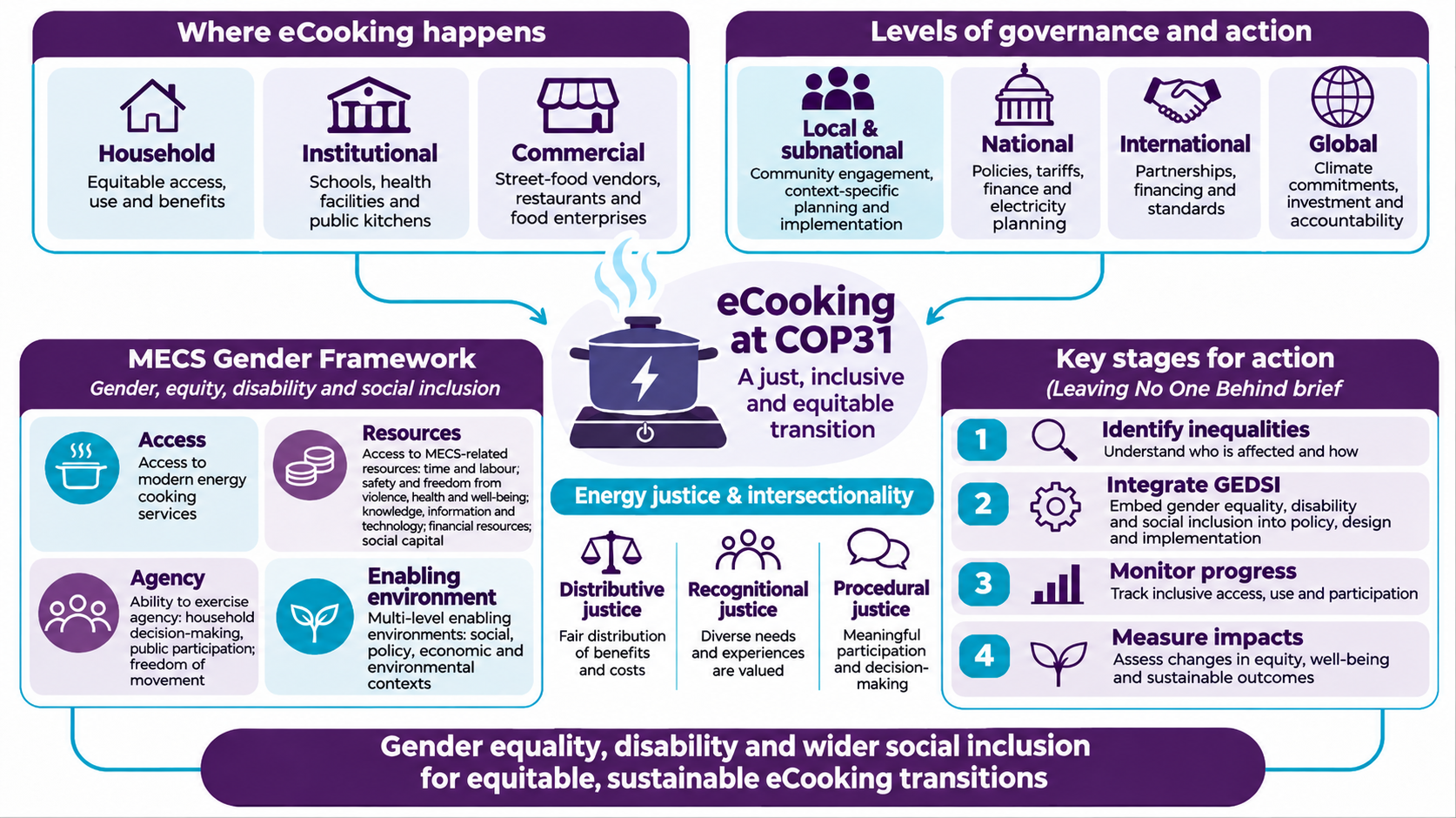
This focus on outcomes provides an important starting point. An additional focus on energy justice extends the discussion to how benefits and costs are distributed, how different needs and circumstances are considered, and who participates in decisions about energy transitions. These correspond to the three established dimensions of energy justice: distributive, recognitional and procedural justice.
An intersectional perspective adds an understanding of how gender interacts with other socio-economic factors to produce different experiences of energy access and use. Cleaner technologies alone cannot resolve inequalities embedded in social and economic systems.
Given the growing role being assigned to cooking within the wider discussions of electrification that took centre stage at COP, in what follows I trace some of the ways in which such discussions are being (or need to be more) grounded within the intersectional justice dimensions considered above.
Embedding justice where eCooking happens
At the household level, electricity connections and access to eCooking appliances do not guarantee equitable use or benefits. Cooking responsibilities, household resources, control over expenditure and social norms all influence adoption and everyday experiences. Women frequently undertake most cooking activities while having limited control over financial decisions. People with disabilities may encounter barriers related to appliance accessibility and kitchen arrangements, while low-income households can face additional constraints associated with connection costs, inadequate wiring and access to finance.
These inequalities often overlap and interact with existing household dynamics. Depending on social context and everyday practices, access to electricity can either sustain existing gender inequalities or contribute to changing them. MECS research highlights the importance of distinguishing immediate benefits, such as reduced cooking time, from wider changes in gender relations. While time savings may reduce women’s daily workload, they do not necessarily translate into greater decision-making power, economic opportunities or fair distribution of unpaid care work.
Similar considerations apply to institutional cooking, where eCooking can affect cooks, students, staff and public service budgets. At COP31, Lesotho’s Deputy Prime Minister, Justice Nthomeng Majara, referred to the MECS–WFP eCooking pilot in five schools, highlighting reductions in cooking times, energy costs and firewood consumption, alongside improvements in kitchen safety and working conditions. She noted that findings of the pilot provided an important basis for considering the expansion of eCooking in school feeding programmes and other public institutions (speech, 28:34–29:17). While these findings demonstrate the potential of institutional eCooking, inclusive transitions also require attention to cooks’ participation in technology selection, access to training, occupational safety and the allocation of financial savings.
Commercial cooking deserves equivalent attention. Restaurants, street-food vendors, caterers and informal food businesses operate under different conditions, with unequal access to electricity, finance and suitable appliances. Women and low-income entrepreneurs may face additional barriers to investing in eCooking technologies, limiting their opportunities to benefit from lower operating costs, improved working conditions and increased productivity. Addressing these inequalities is important to ensure that smaller and informal businesses are included in the transition.
MECS research in Uganda identified opportunities among street-food vendors, alongside the need for financing and portable appliances suited to their cooking practices. Further MECS research in Kenya and Tanzania explored commercial adoption, including women-led businesses, and identified cost-saving opportunities and practical constraints. In October 2026, CLASP launched Cooking Livelihoods and Income for Microenterprises (CLiME), supporting food vendors in Kenya and Uganda through supply-chain development, financing and policy engagement.
These experiences highlight the importance of participatory and co-design approaches in advancing inclusive eCooking transitions across households, institutions and commercial enterprises. Involving women, people with disabilities, institutional cooks, food entrepreneurs and other underrepresented groups in identifying needs, selecting and testing technologies, and informing implementation can help ensure that interventions respond to diverse cooking practices, accessibility requirements and financial constraints. Such approaches can strengthen meaningful participation in decision-making and support more inclusive outcomes.
Connecting national commitments with local and subnational realities
COP31 provided examples of how countries are integrating eCooking into national energy strategies. Tanzania’s President reported that, as of March 2026, the government had facilitated the distribution of more than 49,000 induction stoves and 7,000 electric cookers (Leaders’ Roundtable, 15:36). Measures supporting this transition include reduced electricity tariffs and appliance financing. TANESCO, Tanzania’s electricity utility, has also introduced an on-bill financing scheme to enable customers to repay appliance costs through prepaid electricity purchases. Similarly, Uganda highlighted its efforts to support eCooking adoption through a dedicated electricity tariff, supply-chain development and initiatives targeting institutional cooking.
At Tanzania’s high-level event on schools and health facilities, Ros Eales, Director of Energy and Climate at the UK Foreign, Commonwealth & Development Office (FCDO), noted:
“Reliable affordable power can unlock clean cooking, create demand and strengthen the case for investment.”
Realising this potential requires attention to the different conditions shaping eCooking transitions within countries. The recent MECS study, Enhancing subnational planning for accelerating the eCooking transition, examines Kenya, Uganda, Ghana, Ethiopia, Malawi and Nepal, identifying governance, financing, infrastructure readiness, gender equality and social inclusion, local cooking practices and political economy as interconnected factors affecting implementation. In Kenya, County Energy Plans (CEPs) offer opportunities to align local priorities with national ambitions, but their effectiveness depends on integration into budgets and investment processes. In Nepal, widespread electricity access can coexist, but inadequate household wiring and low-capacity connections restrict eCooking. The JustGESI project is extending this analysis into supporting the integration of gender equality and social inclusion in clean cooking transitions in Ethiopia, Malawi, Mozambique and Tanzania, with a focus on institutional change, policy reform and capacity building.
These differences highlight the importance of local and subnational actors in implementing national commitments. Municipalities, community organisations and other local stakeholders can help identify inequalities, reflect diverse cooking needs and facilitate participation in planning and decision-making. Connecting these priorities with infrastructure investment, utility planning, public services and financial resources can help ensure that national commitments translate into inclusive eCooking transitions that respond to local conditions.
Women’s participation and the wider inclusion agenda
Women’s participation across eCooking value chains also featured in COP31 discussions. Lesotho’s Deputy Prime Minister, Justice Nthomeng Majara, called for women to become “active participants in policy development, entrepreneurship, manufacturing and distribution” (Leaders’ Roundtable, 33:25). Her remarks acknowledged women’s potential contributions as policymakers, professionals, entrepreneurs and industry participants.
Meaningful participation depends on access to finance, education, skills, information, professional networks and decision-making opportunities. Women are not a homogeneous group: their experiences differ according to income, disability, age, location and other intersecting inequalities. A review of 46 energy frameworks across 18 sub-Saharan African countries found that social inclusion was frequently overlooked and that most frameworks lacked clearly defined, measurable gender indicators.
At COP31, a dedicated WHO–IEA–Gender and Energy Compact session addressed the gendered health impacts of energy interventions, adding another dimension to discussions about equitable outcomes. These issues were also discussed during a bilateral meeting which involved representatives of the Ministry of Gender, Children and Social Welfare and Ministry of Environment, Climate Change and Natural Resources of Gambia, Prof. Ed Research Director of the MECS programme, and Alicia Butterfield, Global Manager of the GeCCo Secretariat, exploring opportunities for collaboration to improve women’s health, reduce domestic workloads and advance gender equality through affordable clean cooking solutions.
Advancing gender-transformative and socially inclusive eCooking transitions requires more than increasing women’s participation. It involves addressing structural inequalities and power relations affecting access to resources, decision-making and the distribution of benefits and burdens, while embedding inclusion within policies, institutions and implementation processes to achieve measurable and sustained outcomes.
Making international and global commitments work for everyone
International finance and partnerships were central to COP31 discussions. According to the IEA, more than one-third of the USD 2.2 billion committed at the 2024 Paris Summit on Clean Cooking in Africa has been deployed across 28 African countries. These commitments support clean cooking more broadly, including different fuels and technologies, with eCooking forming part of the wider transition.
International carbon markets also offer opportunities for eCooking investment. One example is Ghana’s Article 6.2 cooperation with Switzerland, which supports the distribution of induction cookers to low-income households through carbon finance. Such mechanisms can reduce financial barriers, although eligibility criteria, financing arrangements and monitoring requirements influence accessibility and the distribution of benefits.
At the global level, climate commitments, financing mechanisms and monitoring frameworks influence national investment priorities and the outcomes used to assess progress. Ensuring that equity is integrated into these systems is important for sustaining inclusive transitions.
MECS has developed practical resources to support this process. The brief Leaving No One Behind: Embedding GEDSI in Modern Energy Cooking Transitions identifies four interconnected stages: identifying inequalities, integrating gender equity, disability and social inclusion into policy and practice, monitoring progress and measuring impacts. The MECS Gender Framework complements this approach through indicators covering access to modern energy cooking services, access to related resources, agency and the multi-level enabling environment. These resources can support the assessment of differentiated outcomes, inform more equitable interventions and strengthen accountability throughout eCooking transitions.
Towards a just and inclusive eCooking transition
COP31 has provided further evidence of political commitment to scaling eCooking and connecting it with electrification, finance, public services and wider development priorities. The challenge now is to ensure that these commitments translate into sustained progress while addressing inequalities across households, institutions, businesses and communities.
Progress towards a just eCooking transition should be assessed through equitable access, meaningful participation and measurable improvements in people’s lives, alongside the expansion of technologies and infrastructure. Achieving this requires coordinated action across local, subnational, national, international and global levels, supported by disaggregated evidence, inclusive decision-making and accountability for outcomes.
******************************************************************************************************
Featured Image: The infographic was created using ChatGPT with author’s prompts.
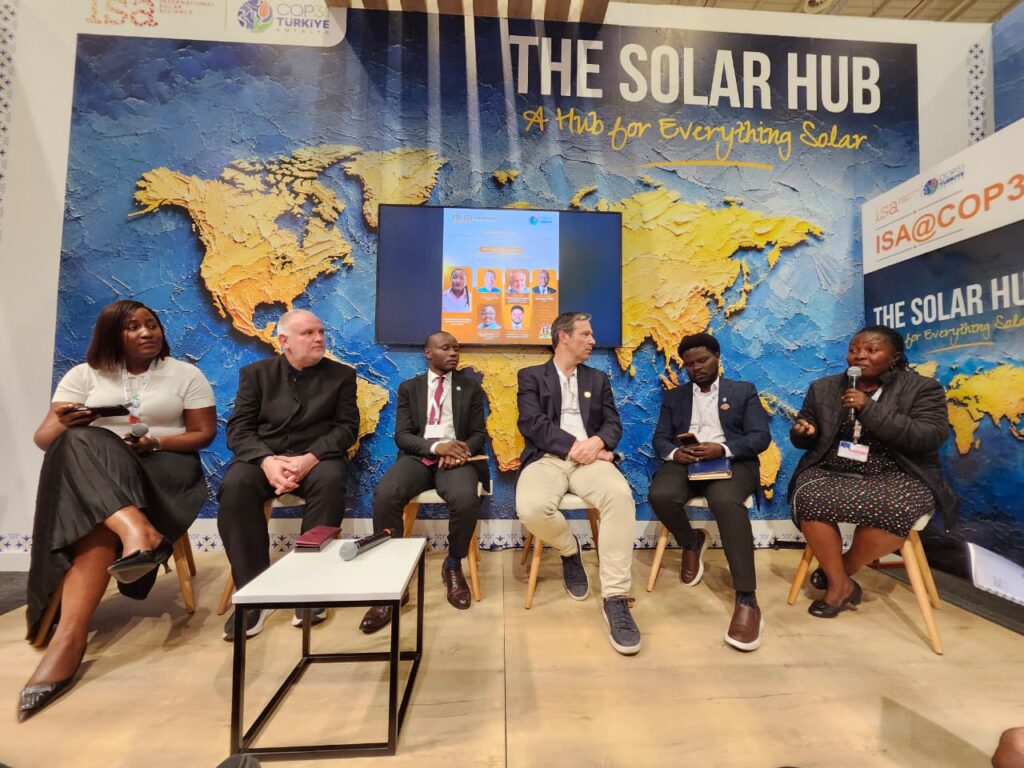
Figure 1: Panel discussion at COP31 side event “From pilots to scale: Accelerating institutional clean cooking through renewable energy, finance & regional partnerships”, organised by Uganda’s Ministry of Energy and Mineral Development at the International Solar Alliance (ISA) Pavilion, Antalya, Türkiye, on 16 November 2026. Panellists and moderator (from left to right): Gertrude Tuhairwe, National Coordinator of the Local Project, Ministry of Local Government; Prof. Ed Brown, Research Director and Leader of the Modern Energy Cooking Services (MECS) Programme; David Baleese, Carbon Markets Advisor, Global Green Growth Institute (GGGI); Brent Chism, Chief Executive Officer, UpEnergy; Desmond Tutu Opio, M&E Manager, Uganda Energy Credit Capitalisation Company (UECCC); and Justine Akumu (moderator), Senior Clean Cooking Officer, Ministry of Energy and Mineral Development, Uganda. Photo credit: Nyamolo Abagi, Director of Clean Energy Access at CLASP.
AI disclaimer: ChatGPT was used to support the drafting and editing process. The analysis, interpretation and final content were reviewed, refined and authored by Yesmeen Khalifa.